
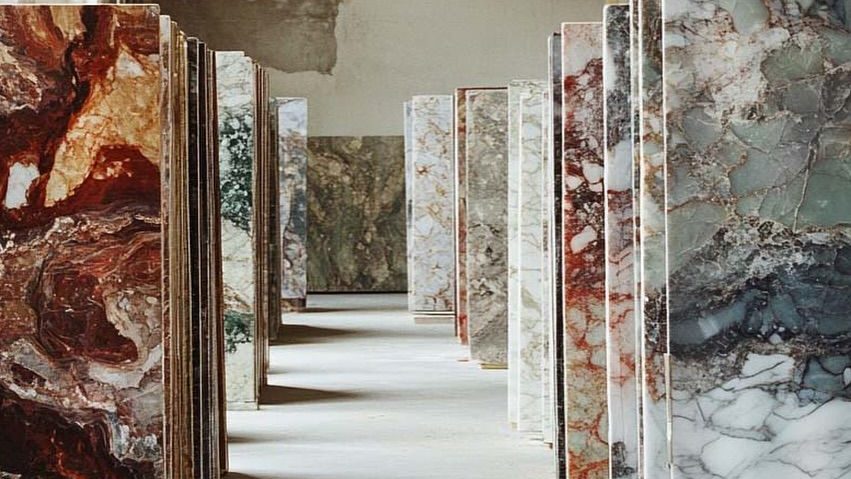
Natural stone can sometimes come with a higher price tag than manufactured surfaces, which naturally leads to the question: why?
The answer is not simply that natural stone is more expensive.
There is a lot that happens before a slab ever reaches a kitchen, bathroom or feature wall. From quarrying and cutting to finishing, transport and selection, natural stone goes through a long process before it is ready to be used in a home.
You are also choosing something that cannot be reproduced exactly. Every slab is different, and that individuality plays a big part in its value.
It starts at the quarry
Natural stone begins as a large block extracted directly from the earth.
Depending on the stone, this may happen in quarries in countries such as Italy, Brazil, Greece or other parts of the world.
The blocks are carefully removed, transported and cut into individual slabs. Each slab then needs to be finished, inspected and prepared before it is ready to be shipped.
Unlike manufactured surfaces, natural stone is not created to a standard pattern or produced on demand.
The material already exists in nature, and the process is about carefully extracting and preparing it.
No two slabs are exactly the same
One of the biggest differences between natural and manufactured stone is variation.
Every natural stone slab has its own combination of colour, veining, movement and texture.
Even slabs cut from the same block can look slightly different from one another.
Some blocks may produce dramatic veining or particularly sought-after colours, while others may contain fewer usable slabs.
That natural rarity can influence the price.
With manufactured stone, patterns can often be reproduced again and again. With natural stone, once a particular slab is sold, there may never be another one exactly like it.
Some stones are rarer than others
Not all natural stone is priced the same.
Some materials are widely available, while others are much harder to source.
Certain colours, patterns and types of stone may only come from particular quarries or may only be available in limited quantities.
Highly sought-after stones can therefore cost more simply because there is less of them available.
The quality of the block, the amount of usable material and the overall appearance of the slabs can all affect pricing.
Getting the stone here takes time
Natural stone often travels a long way before it reaches Australia.
After being quarried and processed, the slabs need to be carefully packed, transported, shipped and handled.
Stone is heavy and fragile, so moving it safely requires specialised equipment and careful handling throughout the journey.
Shipping costs, transport, storage and handling all contribute to the final price of the material.
By the time you see a slab in a showroom, it has already travelled through several stages behind the scenes.
You are paying for the individual slab
With natural stone, you are not simply choosing a colour from a sample.
You are choosing the actual slab that will become part of your home.
The pattern, movement and veining you see in that slab are completely unique.
This is why viewing natural stone in person can be so important. Two slabs with the same stone name can look quite different.
That individuality is one of the reasons natural stone continues to be used in high-end residential and architectural projects.
Natural stone and manufactured stone offer different things
Manufactured stone can be a great option when consistency and predictability are important.
Natural stone offers something different.
It brings natural variation, depth and movement that cannot be perfectly replicated by a manufactured surface.
Neither option is automatically better for every project. It comes down to what you value in the space, how the surface will be used and the overall look you are trying to achieve.
So, what are you paying for?
The price of natural stone reflects much more than the slab itself.
It includes the quarrying process, cutting, finishing, transport, handling, rarity and the fact that every piece is unique.
You are choosing a material that has been formed naturally over millions of years and will never be reproduced in exactly the same way.
For many homeowners, designers and architects, that individuality is what makes natural stone worth the investment.